

Many large Norwegian companies with weak finances over time have received public support in recent weeks. Have we been too kind to Norwegian businesses?
On 13 May 2020, economics professor Gisle Natvik wrote in DN that it is wrong for many companies that take high risks in normal times now to be rescued from their losses. He is backed by economics professor Magne Mogstad at the University of Chicago, who is critical of the public support scheme for Norwegian businesses. He believes the state is poorly suited to judging which companies are viable, and that the compensation scheme therefore comes at too high a cost.
Viability was precisely one of the key criteria for the government when it presented the support scheme. Enin wrote a blog post about this in April, referring to the government's own statements: "The authorities' goal is to finance the companies that have the ability to secure future jobs."
Mogstad may well be right that the state is poorly suited to judging which companies are viable, but both public and private organizations have ways of running a check before the "cash support" money goes out. We think that is highly relevant in light of Hegnar's article in Finansavisen, in which he refers to the piece in DN mentioned above.
Public funds should naturally deliver the greatest possible benefit to society in a state of emergency.
That is hardly achieved by sending grants to companies with significantly weak liquidity and a low loss buffer. Companies that in all likelihood would have gone bankrupt within a short time anyway.
The image below shows 28 of the largest companies in the sample of 20.000 that received government grants. Those 28 companies are among those that received the highest grant amounts, from 158.000 to 5,8 million NOK.
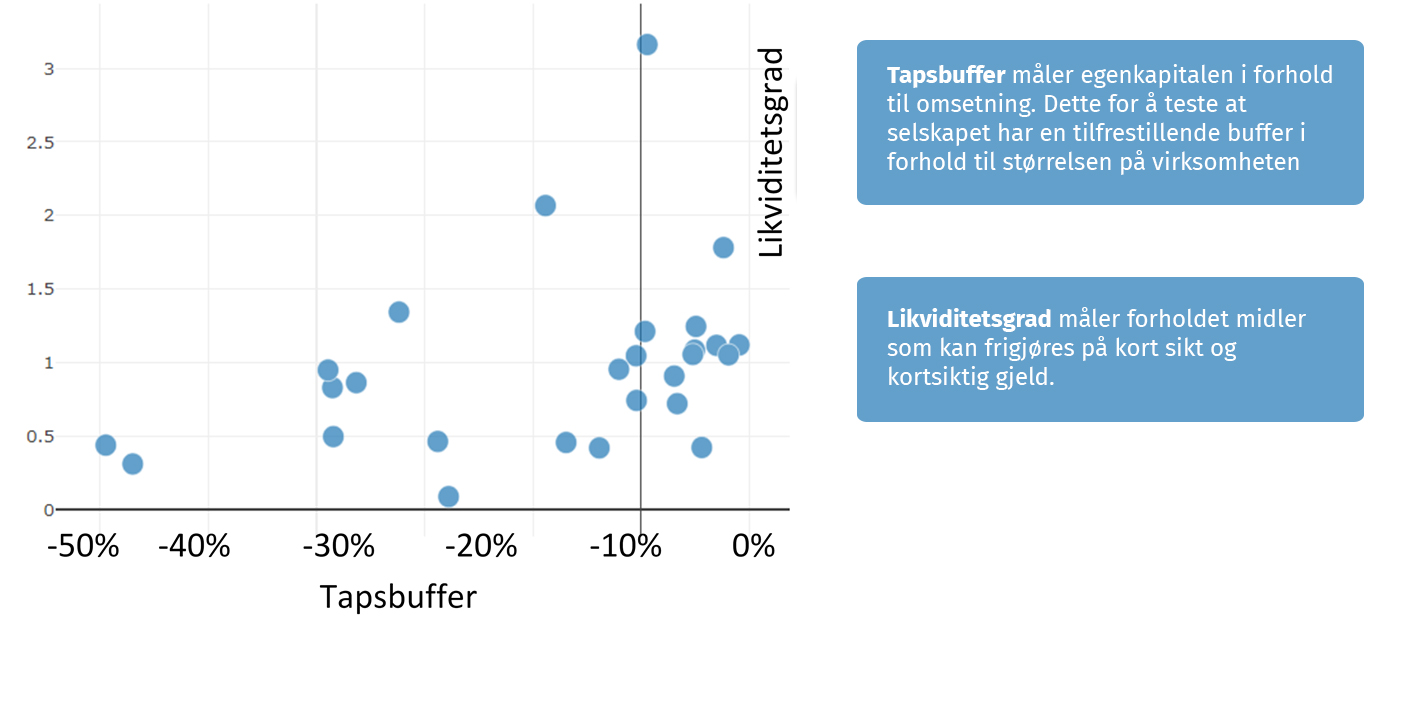
A liquidity ratio below 1 or a loss buffer of less than 0% shows a critical situation for the company's finances. In other words, it indicates that they are not viable over time.
Companies far down and to the left in the plot are characterized by traits such as a falling number of employees over time, a drift towards negative equity, rising debt, negative EBITDA and negative events reported in the media.
Information that is readily available and has a major impact on future financial strength. Shouldn't it be an obligation to gather the data that is available?


